There is a moment in every custom corporate bag order that feels like a milestone but functions more like a false checkpoint. The buyer receives the pre-production sample, examines the canvas weight, checks the print registration, pulls on the handles, and sends back the approval. From that point forward, the buyer operates under a reasonable assumption: the factory now knows exactly what to produce. The sample is the standard. Everything that follows should match it.
From inside a production facility, that approval means something different. It means the buyer is satisfied with the outcome — the appearance, the feel, the structural impression of the piece in hand. It does not mean the buyer has documented the input materials that produced that outcome. And in the absence of a material specification document, the factory retains full operational discretion over what goes into the bulk run.
This is not deception. It is a structural gap in how sample approval is understood by the two parties involved. The buyer treats sample approval as a specification freeze event. The factory treats it as a quality benchmark confirmation. These are not the same thing, and the distance between them is where most bulk production disappointments originate.
The mechanics of how this gap forms are worth understanding in detail. When a factory produces a pre-production sample for a custom tote bag or corporate gift order, it typically draws from available inventory. If the specification sheet says "canvas tote, navy, 15×16 inches," the factory will use whatever canvas stock is on hand — which might be 320gsm, 300gsm, or 280gsm depending on what arrived most recently from their fabric supplier. The sample is built to look right and feel right. The specific gsm value is not recorded in the approval documentation because no one asked for it to be.
The buyer approves the sample. The purchase order is issued. The PO references the approved sample as the quality standard. The factory begins bulk production — and at this point, the production manager faces a routine cost optimization decision. The fabric supplier has quoted a slightly different batch. The gsm is 280 instead of 320. The visual difference is imperceptible. The color match is within tolerance. The handle attachment points are identical. The factory's interpretation of "matching the approved sample" is entirely visual and functional — not compositional.
Six months after delivery, the bags begin showing accelerated wear at the base corners and handle attachment seams. The buyer contacts the factory. The factory produces the approved sample alongside a bulk unit. They look identical. The factory points to the purchase order: "canvas tote, navy, 15×16 inches, matching approved sample." Every specification on the PO has been met. The material composition was never specified.

What makes this pattern particularly difficult to address after the fact is that the factory has not violated any documented agreement. The gap exists in the space between what the buyer assumed was locked and what was actually written down. In practice, this is where corporate gift procurement decisions start to generate consequences that appear months after the order closes — long after the event the bags were purchased for, and often after the procurement team has moved on to the next project.
The assumption that sample approval locks specifications is reinforced by the way most corporate gift procurement cycles are structured. The timeline pressure is real: a company needs 500 custom tote bags for a conference in eight weeks. The sample arrives, looks good, gets approved, and the order is placed. There is no natural pause in that sequence for a material specification review. The urgency of the event deadline compresses the window between approval and order placement to the point where specification documentation feels like an unnecessary delay.
What procurement professionals who have run multiple custom bag programs understand — and what first-time or infrequent buyers typically do not — is that the specification document is not a bureaucratic formality. It is the only mechanism that converts a sample approval from a visual confirmation into a production commitment. Without it, the factory is producing to a visual standard, not a material standard. Those are different instructions.
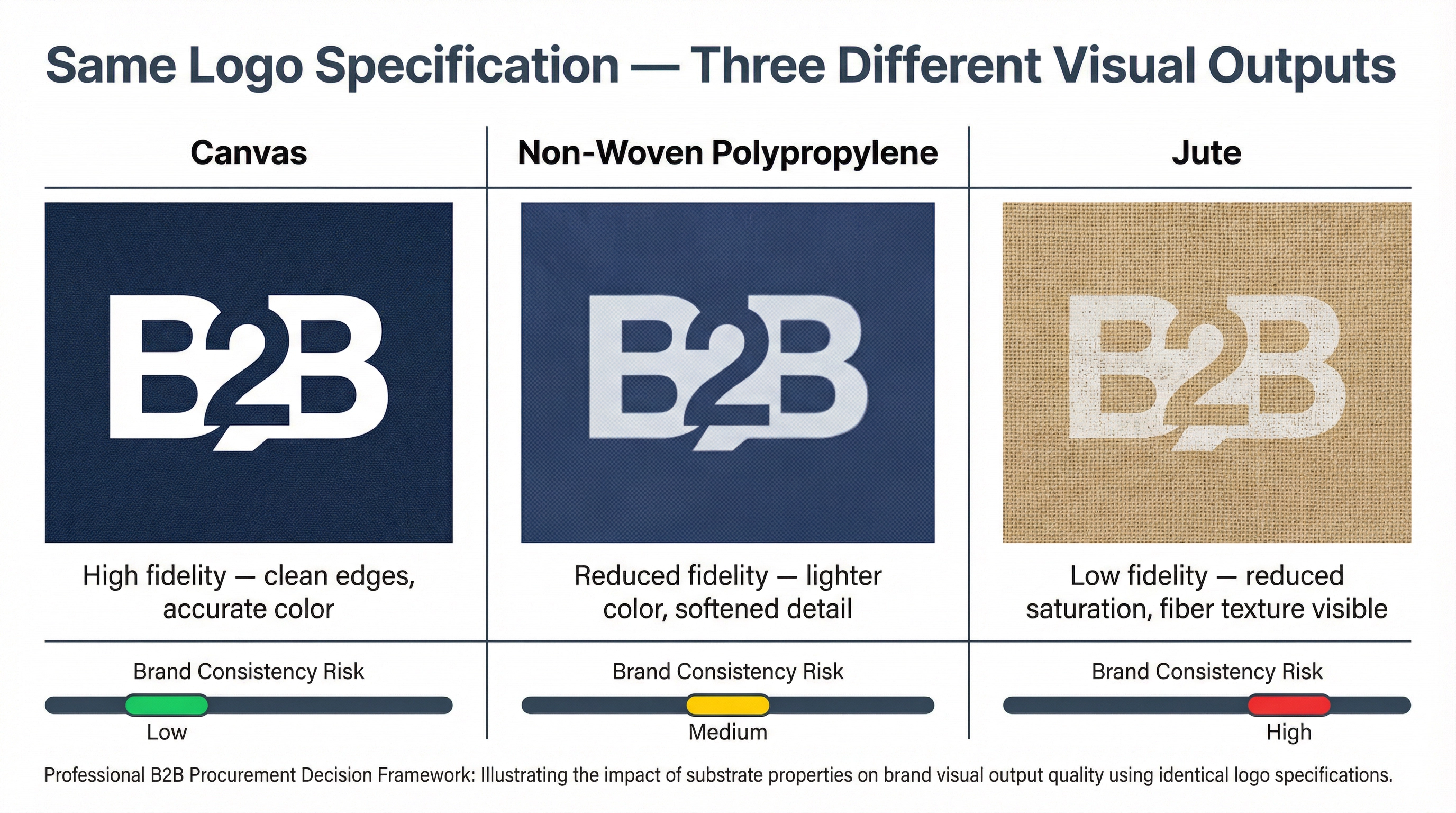
The practical consequence of this gap extends beyond individual order quality. For companies that use custom reusable bags as a recurring element of their corporate gifting or event strategy — and the question of which gift format best serves a particular business objective is one that deserves careful structural planning, as any systematic approach to matching gift types with business needs will address — the absence of locked specifications means that each reorder cycle introduces material variation risk. The bags from the second order may look identical to the first but perform differently under use conditions. Brand consistency, which is one of the primary reasons companies invest in custom bags rather than generic alternatives, is undermined not by visible defects but by compositional drift that only becomes apparent over time.
The specification gap window is the period between sample approval and purchase order finalization. It typically lasts between 24 and 72 hours in a compressed procurement cycle. Closing that window requires one specific action: before the PO is issued, the buyer must request a material specification confirmation from the factory that documents the exact fabric weight (gsm), weave type, handle material and dimensions, hardware grade if applicable, and lining material if present. This document should be attached to the PO as an exhibit, not referenced informally in email.
Factories that operate at a professional level will provide this documentation without resistance. The request itself signals to the production team that the buyer is tracking material inputs, not just visual outcomes — which changes the internal calculus around cost optimization decisions during bulk production. A factory that knows the buyer has documented 320gsm canvas in the PO will not substitute 280gsm without a formal change request. A factory that knows the buyer approved a sample without documenting the gsm will make substitution decisions based on cost efficiency alone.
The distinction between a sample that demonstrates quality and a specification document that defines quality is not a subtle one once you have seen the consequences of conflating the two. The sample shows what the product should look and feel like. The specification document defines the material conditions under which that outcome is reproducible at scale. Both are necessary. Neither replaces the other.