Corporate buyers ordering custom reusable bags typically view the sample approval phase as a decision checkpoint—a moment to verify that the supplier understood the specifications correctly before committing to full production. This framing makes intuitive sense. The sample arrives, stakeholders review it, and if adjustments are needed, those changes get communicated before the factory begins manufacturing the bulk order. From the buyer's perspective, this represents responsible procurement: validate first, then proceed.
What this framing obscures, however, is the reality of how material procurement timelines intersect with the sample production process. Buyers tend to assume that material sourcing begins after sample approval, as part of the transition into bulk manufacturing. In practice, material procurement begins immediately after the purchase order is confirmed—often days before the first sample is even produced. The sample itself is typically made from materials that have already been ordered or, in some cases, from the same material batch that will be used for the full production run.
This timing mismatch creates a cascade of consequences when a buyer decides to change material specifications after reviewing the sample. A procurement manager might look at the approved sample and conclude that the standard canvas weight feels too light, or that organic cotton would better align with the company's sustainability messaging. From the buyer's standpoint, this decision is being made early in the process—before any bags have been manufactured. From the supplier's standpoint, this decision is being made after materials have already been sourced, vendor relationships have been activated, and production schedules have been coordinated around the availability of those specific materials.
The reason material procurement starts so early lies in the lead times required to source textile components for custom bag production. Canvas, webbing, zippers, and reinforcement materials are not typically held in inventory by bag manufacturers in the specific colors, weights, and certifications that corporate buyers request. When a purchase order specifies navy blue organic cotton canvas with a particular GSM weight, the factory must order that fabric from a textile mill or distributor. Depending on the specification, this procurement cycle can require two to four weeks, particularly if the fabric needs to be dyed to match a custom Pantone color or if it requires third-party certification documentation.
Factories cannot afford to wait until sample approval to begin this procurement process. If they did, the timeline from sample approval to delivery would extend by an additional three to four weeks solely for material lead time, making the overall project timeline uncompetitive. Instead, suppliers initiate material procurement in parallel with sample production. The purchase order confirmation triggers both processes simultaneously: the sample team begins producing a prototype, while the sourcing team begins ordering the materials needed for bulk production.
This parallel workflow is efficient when specifications remain stable. The sample gets produced, the buyer approves it, and the bulk materials arrive at the factory just as production capacity becomes available. The entire process flows smoothly because the material procurement timeline was front-loaded. Problems emerge when the buyer requests a material change after seeing the sample. Even if the buyer communicates this change within days of receiving the sample—well before the factory has cut a single piece of fabric for the bulk order—the change still disrupts the material procurement cycle that has already been set in motion.
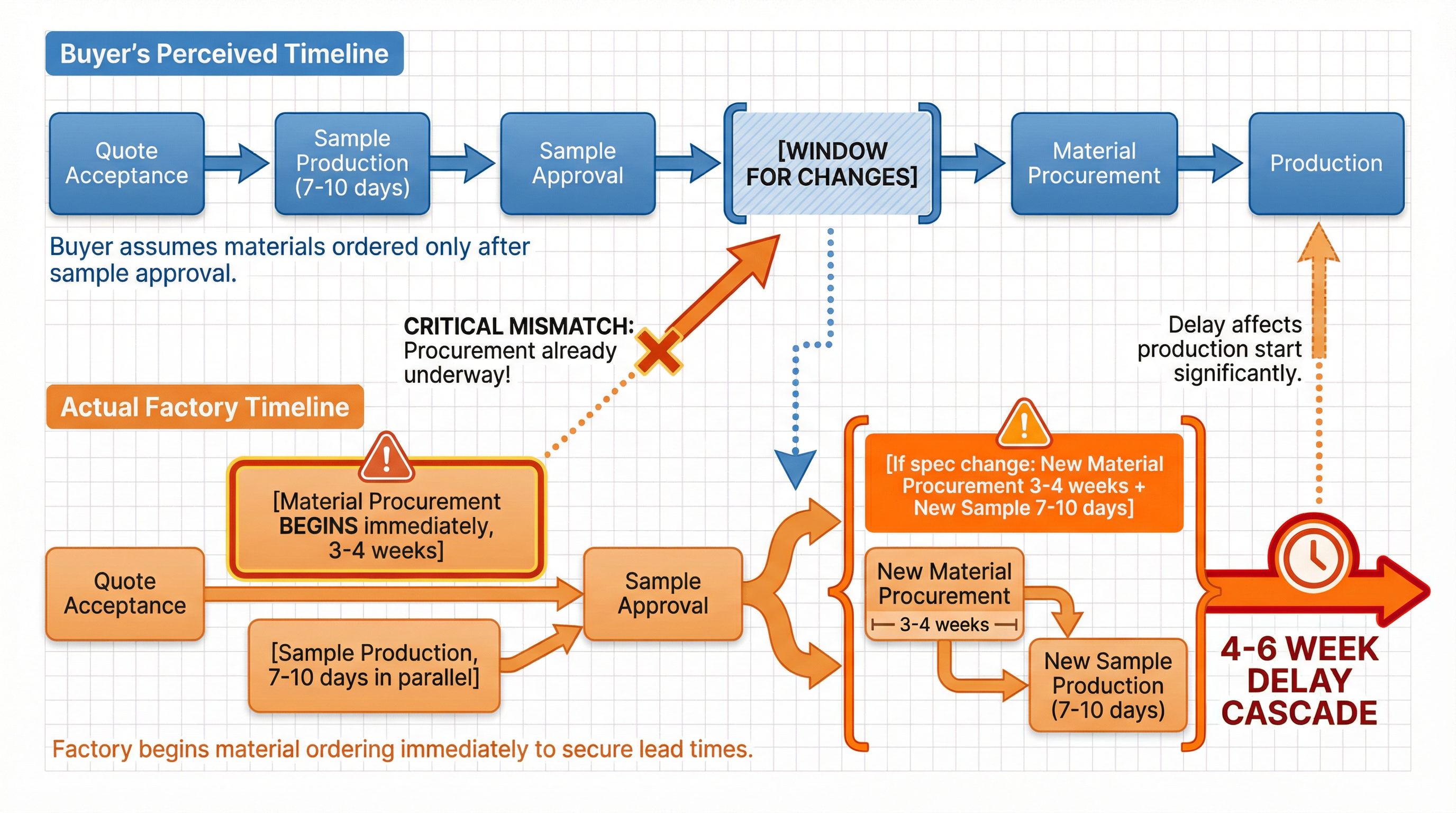
Consider a scenario where a buyer orders 2,000 custom tote bags made from 12-ounce natural canvas. The factory confirms the order, begins producing a sample, and simultaneously orders the canvas from their textile supplier. The canvas order requires a three-week lead time because the mill needs to weave the fabric to the specified weight and width. Two weeks into this process, the buyer receives the sample, reviews it with their sustainability team, and decides that organic cotton would be a better choice for brand alignment. The buyer communicates this change to the supplier, expecting that it can be accommodated because production has not yet started.
From the factory's perspective, this change requires several immediate actions. First, they must determine whether the already-ordered natural canvas can be canceled or redirected to another project. In many cases, textile orders cannot be canceled once production has begun at the mill, meaning the factory absorbs the cost of materials that can no longer be used for this project. Second, they must source organic cotton canvas, which typically has longer lead times than conventional canvas because fewer mills produce it and because organic certification documentation must be verified. This new procurement cycle adds another three to four weeks to the timeline.
Third, the factory must produce a new sample using the organic cotton, because the buyer needs to verify that the new material meets their expectations before bulk production begins. This sample production adds another seven to ten days. Fourth, the factory must wait for the buyer to approve the new sample, which introduces another variable timeline depending on the buyer's internal review process. Only after this second sample is approved can the factory finalize their production schedule, assuming the organic cotton has arrived by that point.
The cumulative impact of this sequence is that what the buyer perceived as an early-stage specification adjustment—made before any bulk manufacturing occurred—ends up adding four to six weeks to the overall timeline. The buyer did not request the change after production started. They requested it after sample review, which felt like the appropriate moment for refinement. But because material procurement had already been initiated based on the original specifications, the change effectively reset the procurement timeline, creating a cascade of delays that were invisible to the buyer when they made the decision.
This dynamic is particularly pronounced when the specification change involves materials that require compliance documentation or third-party certification. Organic cotton, recycled polyester, and materials with specific environmental certifications all require additional verification steps that extend procurement timelines. When a buyer switches from a standard material to a certified material after sample approval, they are not simply requesting a different fabric—they are requesting a different supply chain with different lead times and different documentation requirements.
The same principle applies to changes in material weight, color matching, or construction methods. A buyer might review the sample and decide that the bag needs reinforced stitching at stress points, or that the handles should be attached differently for better load distribution. These changes may seem minor from a design perspective, but they can require different materials or different production processes, both of which have procurement and scheduling implications. A switch from standard webbing to reinforced webbing, for example, might require sourcing from a different supplier with a different lead time. A change in stitching method might require the factory to reserve time on a different type of sewing machine, which affects production scheduling.
Buyers who understand this timing structure tend to approach the customization process differently. They invest more effort in finalizing material specifications before the purchase order is confirmed, rather than treating the sample phase as an opportunity for iterative refinement. They request material swatches or reference samples before committing to a specification, so that decisions about fabric weight, texture, and color are made based on physical evaluation rather than abstract descriptions. They recognize that the purchase order confirmation is the point at which material procurement begins, not the point at which the factory starts thinking about sourcing.
For organizations that need flexibility to adjust specifications based on sample review, the more effective approach involves building that flexibility into the timeline from the beginning. Instead of assuming that sample approval will be a quick formality, they allocate two to three weeks for internal review and potential revisions. They communicate to the supplier that material procurement should not begin until after the first sample is approved, accepting that this will extend the overall timeline by three to four weeks. This approach trades speed for flexibility, but it does so transparently, with both parties understanding the timeline implications.
The alternative—requesting material changes after sample approval while expecting minimal timeline impact—consistently produces friction and disappointment. The buyer feels that they made the change early enough to avoid delays, while the supplier explains that the change requires restarting the material procurement cycle. Neither party is wrong, but they are operating from different understandings of when material procurement begins and what constitutes an "early" change.
From a compliance and quality assurance standpoint, the specification lock-in point is not when production starts—it is when the purchase order is confirmed. That is the moment when the supplier begins coordinating with their material vendors, reserving production capacity, and scheduling the various steps required to fulfill the order. Changes made after that point are not impossible, but they are disruptive in ways that are difficult to fully recover. The factory can accommodate the change, but they cannot undo the procurement and scheduling decisions that were already made based on the original specifications.
For procurement teams evaluating their approach to custom bag projects, the relevant question is not whether a specification change is technically feasible, but whether it aligns with the material procurement timeline that has already been initiated. Understanding that material sourcing begins at purchase order confirmation, rather than at sample approval, fundamentally changes how specification decisions are sequenced. It shifts the emphasis from iterative refinement during the sample phase to upfront clarity before the order is placed. That shift, in turn, reduces the likelihood of encountering the specification lock-in cascade, where a seemingly early change triggers a multi-week delay because it conflicts with procurement activities that were already underway.