Employee onboarding kits have become one of the most consistent use cases for custom reusable bags in U.S. corporate procurement. The bag serves a dual function: it is the container that delivers the kit on day one, and it is a branded item the new hire is expected to use beyond that first day. This dual-function requirement is what makes the specification decision more consequential than it appears. A bag that is sized and structured for the contents of the kit but not for the employee's daily commute will be used once and set aside. A bag that is lightweight enough for daily use but not structured enough to hold a laptop, a water bottle, and a company handbook without losing its shape will fail the first function. Getting both right requires working backward from two separate use cases simultaneously — and most procurement briefs only account for one.
The starting point for any onboarding bag specification is an accurate inventory of what the kit actually contains and what it weighs. This sounds obvious, but in practice, the bag is often selected before the kit contents are finalized, which means the specification is based on an assumed load rather than a measured one. A typical corporate onboarding kit in 2025 includes a branded notebook, a pen set, a company handbook or welcome booklet, a water bottle or tumbler, a laptop sleeve or tech accessory pouch, and occasionally a branded apparel item such as a t-shirt or hoodie. The combined weight of these items ranges from approximately 2.5 to 5 pounds depending on the specific selections, and the volume ranges from roughly 1,500 to 2,500 cubic centimeters. These numbers matter because they directly determine the minimum canvas weight and structural requirements the bag needs to meet.
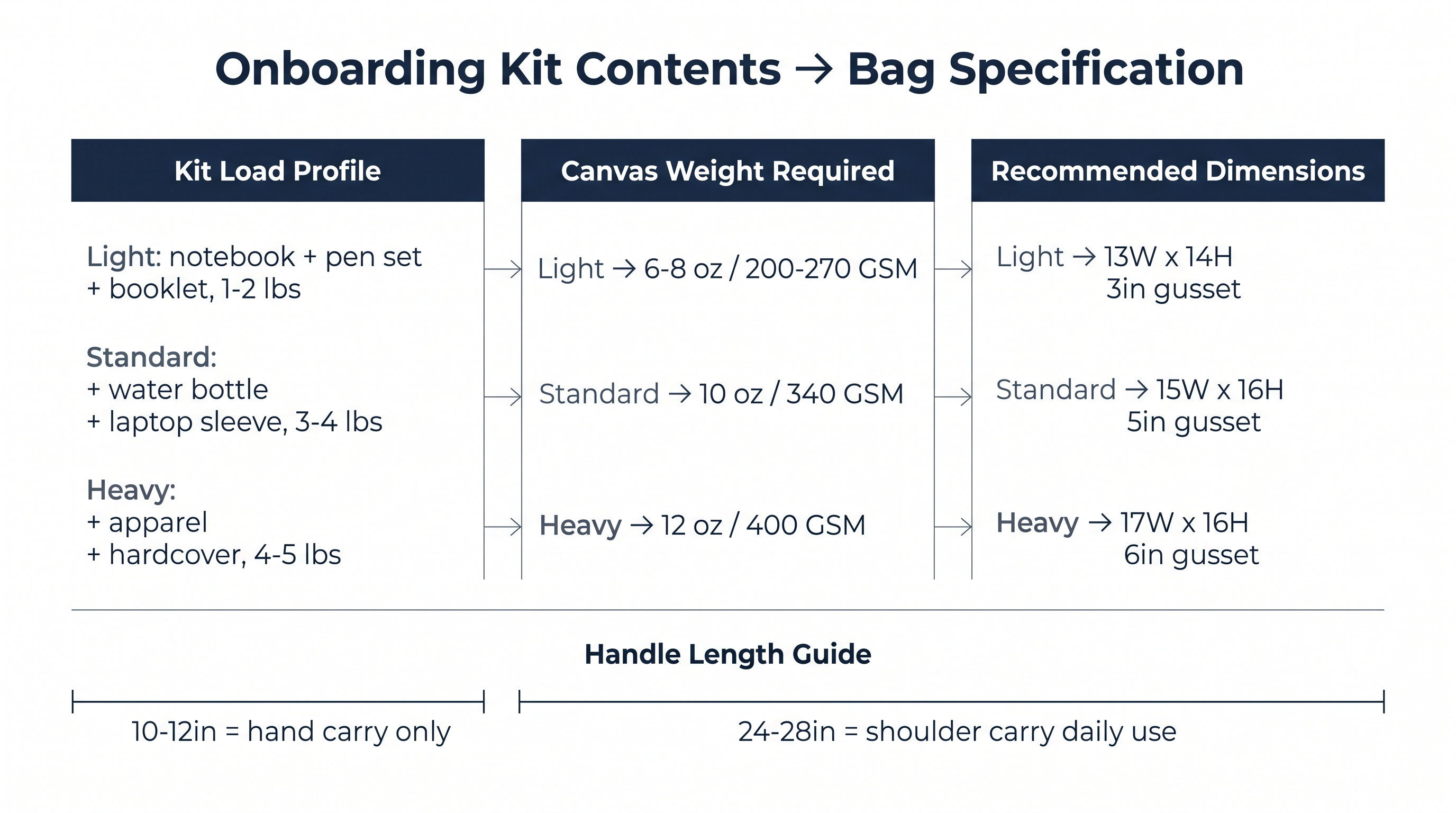
Canvas weight is measured in grams per square meter (GSM) or ounces per square yard (oz). For onboarding kits that include a water bottle and a laptop sleeve, the minimum practical canvas weight is 10 oz (approximately 340 GSM). At this weight, the bag holds its shape under a 4–5 pound load without the sides collapsing inward, and the base maintains enough rigidity to prevent the contents from shifting during transit. Bags in the 6–8 oz range (200–270 GSM) are appropriate for lighter kits — a notebook, a pen set, and a branded booklet — but will visibly deform under the weight of a full onboarding kit, which creates a poor first impression regardless of the print quality. The 12 oz (400 GSM) tier is appropriate for kits that include heavier items such as a hardcover book, a full-size tumbler, or a packaged apparel item, and it is the specification most commonly used for premium onboarding programs at technology and financial services companies. Specifying canvas weight based on the lightest anticipated kit contents — rather than the heaviest — is the most common structural error in onboarding bag procurement.
Bag dimensions are the second specification variable, and they interact with canvas weight in ways that are not always intuitive. A bag that is dimensionally large enough to hold all kit contents but constructed from a lighter canvas will still deform under load because the larger surface area amplifies the structural stress on the fabric. The standard onboarding bag dimensions used by most U.S. corporate procurement teams are 15 inches wide by 16 inches tall with a 5–6 inch gusset. This configuration provides approximately 1,440–1,728 cubic inches of interior volume, which is sufficient for all standard onboarding kit configurations including a 13-inch laptop sleeve. For kits that include a 15-inch laptop sleeve or a bulky apparel item, the width should be extended to 17–18 inches to prevent the bag from bulging at the sides when fully loaded. The gusset depth — the flat bottom panel that gives the bag its three-dimensional structure — is the dimension most frequently underspecified. A 3-inch gusset is adequate for flat items but will not accommodate a water bottle standing upright alongside other contents. A 5–6 inch gusset is the practical minimum for any kit that includes a cylindrical item.
Handle length determines whether the bag functions as a hand-carry item, a forearm carry, or a shoulder bag — and this distinction has a direct effect on whether new hires use the bag after day one. A handle length of 10–12 inches (measured from the top of the bag to the midpoint of the handle) positions the bag as a hand-carry item, which is appropriate for the delivery moment but limits daily utility for employees who commute by public transit or walk significant distances. A handle length of 24–28 inches allows the bag to be carried over the shoulder, which is the configuration most likely to result in regular use. The 20–22 inch range is a compromise that works for forearm carry but is too short for comfortable shoulder carry on most adults. For onboarding bags intended to function as daily-use items beyond the kit delivery moment, 26 inches is the specification that produces the highest post-onboarding retention rate across different body types and commute styles.
Print method selection for onboarding bags involves a trade-off between visual impact on day one and brand longevity over repeated use. Screen printing produces the highest color vibrancy and is the most cost-effective method for orders above 500 units, but the ink layer sits on top of the canvas surface and is subject to cracking and fading after repeated washing. For onboarding bags that will be used daily and washed regularly, embroidery provides significantly better durability — the thread is integrated into the fabric structure rather than applied to the surface — but it limits the logo to a maximum of approximately 3–4 colors and is not suitable for designs with fine detail or gradients. Heat transfer printing offers a middle position: it accommodates full-color designs and photographic detail, but the adhesive layer degrades faster than screen print ink under high-frequency washing conditions. The practical recommendation for most onboarding programs is screen printing for standard logo applications on orders above 300 units, and embroidery for premium programs where the bag is intended to function as a long-term daily-use item.
The interior lining specification is a detail that is frequently omitted from procurement briefs but has a meaningful effect on the bag's perceived quality and functional durability. An unlined canvas bag is appropriate for lightweight kits where the contents are not at risk of snagging on the raw interior seams. For kits that include tech accessories, cables, or items with delicate packaging, a cotton or polyester interior lining prevents abrasion damage during transit and gives the bag a more finished appearance when opened. A laminated interior lining — typically a food-grade PE or PEVA coating — adds moisture resistance, which is relevant for kits that include a water bottle or for employees in markets with high precipitation. The lining specification adds approximately $0.80–$1.50 per unit at standard order quantities, which is a cost that is frequently cut during budget optimization but disproportionately affects the recipient's first impression of the kit.
One specification decision that consistently creates problems in onboarding bag programs is the handle attachment method. Handles that are sewn only to the exterior panel of the bag — without reinforcement stitching that passes through to the interior — will begin to separate from the bag body after 6–8 months of regular use under a 3–5 pound load. For an onboarding bag that is intended to represent the company's brand in the employee's daily environment, handle failure is a brand visibility event with negative valence. The correct specification is a handle attachment that uses a box stitch or cross-stitch pattern through both the exterior canvas and an interior reinforcement patch, with a minimum stitch count of 8 stitches per inch at the attachment point. This specification adds minimal cost but extends the functional lifespan of the handle attachment from approximately 8 months to 3–4 years under regular use conditions.
Procurement teams that are selecting custom reusable bags for onboarding programs as part of a broader corporate gifting strategy will find that the specification logic for onboarding bags differs meaningfully from the logic applied to other gifting contexts. The selection criteria that apply across different business gifting scenarios provide a useful framework for understanding why onboarding bags occupy a distinct specification tier — they are not trade show bags scaled up, and they are not client appreciation bags repurposed. They are a product category with their own load requirements, use-case profile, and durability standards, and the specification decisions that produce a successful onboarding bag are driven by those requirements rather than by budget tier or aesthetic preference alone.
The final specification consideration for onboarding bags is lead time, which is directly affected by the customization depth of the order. A standard screen-printed canvas tote in a pre-existing size and color configuration can be produced and shipped within 15–20 business days for orders above 100 units. An order that requires a custom canvas weight, a non-standard gusset depth, an interior lining, and embroidered branding will require 25–35 business days from artwork approval to delivery, with additional time if pre-production samples are required. For organizations that are planning onboarding programs around a specific hire date or cohort start date, the specification decisions made at the procurement stage have a direct effect on whether the bags arrive in time. The most common cause of onboarding bag delays is not production capacity — it is specification changes requested after the initial order confirmation, which reset the production timeline regardless of how far along the order has progressed.