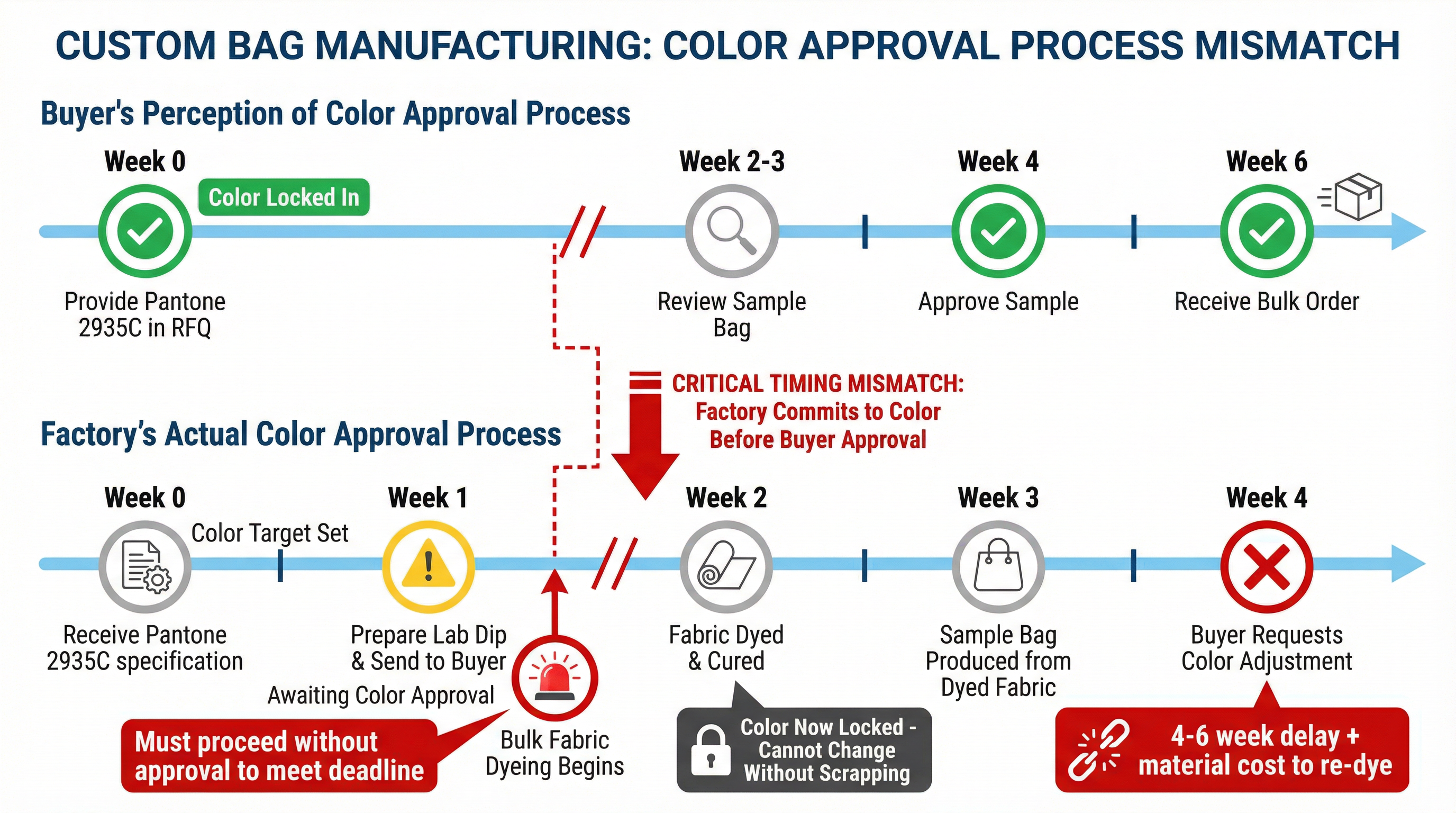
Corporate buyers ordering custom reusable bags for brand activation, employee gifting, or conference distribution typically specify brand colors using Pantone codes—a standardized color matching system that provides a universal reference for designers, printers, and manufacturers. When a buyer includes "Pantone 2935C" in their request for quotation, they reasonably assume this specification locks in the bag's color. The Pantone system exists precisely to eliminate ambiguity: Pantone 2935C should look the same whether printed on paper, embroidered on fabric, or dyed into canvas. From the buyer's perspective, providing a Pantone code at the project's outset constitutes color approval, and the factory's responsibility is simply to match that standard during production. What this framing misses is the distinction between color specification and color approval. Specifying a Pantone code tells the factory which color to target, but it does not confirm that the factory's dyed fabric actually matches the buyer's expectation. Color matching is not a deterministic process where inputting "Pantone 2935C" into a dye formula automatically produces a perfect match. It is an iterative process that requires the factory to prepare lab dips—small swatches of fabric dyed to approximate the target color—and submit those swatches to the buyer for review and approval before bulk fabric dyeing begins. The buyer's approval of a lab dip is what locks in color, not the initial Pantone specification. When buyers skip or delay lab dip approval, assuming that sample approval will serve as the color checkpoint, they force the factory to proceed with bulk dyeing based on an unapproved color standard, creating a cascade of risks that often surface only when the buyer receives the final product and realizes the color does not match their expectation. The reason lab dip approval must happen before bulk dyeing lies in the economics and logistics of fabric procurement. A factory producing 5,000 custom canvas tote bags does not dye fabric in small batches as bags are manufactured. They dye the entire fabric quantity—typically 5,000 to 6,000 yards—in a single dye lot to ensure color consistency across all units. This bulk dyeing happens early in the production timeline, often within the first week after the production order is confirmed, because dyed fabric must cure, be inspected, and then be cut and sewn into bags over the following three to four weeks. If the buyer has not approved a lab dip before this bulk dyeing occurs, the factory must make a judgment call: either delay dyeing until the buyer approves a lab dip, which extends the overall timeline by one to two weeks, or proceed with dyeing based on the factory's interpretation of the Pantone standard, accepting the risk that the buyer might reject the color later. Most factories, under pressure to meet delivery deadlines, choose the latter option. They prepare a lab dip based on the Pantone code provided in the buyer's specifications, send that lab dip to the buyer for review, and simultaneously begin bulk dyeing using the same dye formula. This parallel workflow allows the factory to stay on schedule, but it creates a critical vulnerability: if the buyer reviews the lab dip and requests a color adjustment—perhaps the blue is too dark, or the green has too much yellow—the factory has already dyed thousands of yards of fabric in the original shade. Adjusting the color at this stage requires either re-dyeing the entire fabric lot, which adds four to six weeks to the timeline and incurs significant material and labor costs, or proceeding with the original color and hoping the buyer will accept it once they see the finished bags. The buyer's perspective on this timeline is shaped by their experience with other customization processes, particularly logo printing and embroidery, where color adjustments can be made relatively late in the production cycle. If a buyer orders printed t-shirts and realizes during the sample approval stage that the logo color needs to be adjusted, the printer can simply change the ink color for the bulk run without scrapping any materials. The same flexibility exists for embroidered products: thread colors can be swapped out at any point before bulk embroidery begins. Buyers accustomed to these workflows naturally assume that bag color can be adjusted in a similar manner—that specifying "Pantone 2935C" provides a starting point, and the actual color can be fine-tuned once they see a physical sample. This assumption breaks down when the bag's color is achieved through fabric dyeing rather than surface printing or embroidery. Dyed fabric is not a surface treatment that can be changed after the fact; it is a permanent alteration of the fabric's fibers. Once canvas or non-woven fabric has been dyed, the only way to change its color is to dye it again, and re-dyeing is not a simple adjustment—it is a complete restart of the dyeing process, requiring the fabric to be stripped of its original dye (if possible), re-dyed to the new shade, cured, and inspected. Many fabrics, particularly non-woven polypropylene, cannot be effectively re-dyed at all, meaning a color error on non-woven bags requires scrapping the entire fabric lot and starting over with new material. The factory's challenge is that they cannot communicate this constraint effectively at the project's outset without appearing to add unnecessary complexity. When a buyer provides a Pantone code and the factory responds by saying, "We need you to approve a lab dip before we start dyeing," the buyer often interprets this as a bureaucratic step rather than a critical decision point. The buyer might think, "I already told you the color—Pantone 2935C—why do you need me to approve a swatch? Just match the Pantone." From the buyer's standpoint, the factory is asking for redundant confirmation of something that has already been specified. From the factory's standpoint, they are trying to protect both parties from a costly mistake: if the buyer does not approve the lab dip and later disputes the final color, the factory has no defense, because the buyer never confirmed that the dyed fabric met their expectation. This communication gap is compounded by the fact that Pantone codes are not absolute color standards when applied to fabric. Pantone's color matching system was originally developed for paper and ink, and while Pantone has expanded its system to include textile standards (Pantone TCX and TPX), the appearance of a Pantone color on fabric depends heavily on the fabric's base material, weave structure, and finish. Pantone 2935C on coated paper will look different from Pantone 2935C on canvas, which will look different from Pantone 2935C on non-woven polypropylene. The fabric's texture, sheen, and absorbency all affect how the dye appears, meaning a "perfect" Pantone match on one fabric type might look noticeably different on another. Buyers who are unfamiliar with these material-specific variations assume that Pantone codes provide universal color accuracy, and they become frustrated when the factory's dyed fabric does not match the Pantone swatch they are holding. The buyer might compare the finished bag to a Pantone swatch printed on coated paper and conclude that the factory failed to match the color, when in reality the factory matched the color as closely as possible given the fabric's inherent characteristics. This is why lab dip approval is essential: it allows the buyer to see how the target color will actually appear on the specific fabric being used for their bags, and to make an informed decision about whether that appearance is acceptable before thousands of yards of fabric are dyed. Consider a scenario where a corporate buyer orders 3,000 custom canvas tote bags in their brand's signature blue, specified as Pantone 2935C. The buyer includes this Pantone code in their request for quotation, and the factory confirms they can match it. The factory prepares a sample bag using fabric dyed to approximate Pantone 2935C and sends the sample to the buyer for approval. The buyer reviews the sample and approves it, but notes that the blue seems slightly darker than their brand standard. The buyer assumes this is a sample-specific issue and that the bulk production will be adjusted to match the Pantone more closely. What the buyer does not realize is that the sample bag was made from the same dye lot that will be used for bulk production. The factory dyed 6,000 yards of canvas to Pantone 2935C based on their standard dye formula, used a small portion of that fabric to produce the sample bag, and is now waiting for the buyer's approval to proceed with cutting and sewing the remaining fabric into 3,000 bags. When the buyer approves the sample but comments that the color is too dark, the factory faces a dilemma: the buyer has approved the sample, which legally constitutes approval of the color, but the buyer's comment suggests they are not fully satisfied. The factory proceeds with bulk production, and when the buyer receives the finished bags, they formally reject the color, arguing that it does not match Pantone 2935C and requesting that the factory re-dye the fabric and reproduce the bags. This scenario illustrates how the absence of explicit lab dip approval creates ambiguity that surfaces only after production is complete. If the factory had sent a lab dip to the buyer before dyeing the bulk fabric, the buyer would have seen the exact shade that would be used for production and could have requested a color adjustment before any fabric was dyed. The factory could have prepared a second lab dip with a lighter shade, submitted it for approval, and proceeded with bulk dyeing only after the buyer confirmed the color was acceptable. The entire process would have added one to two weeks to the timeline, but it would have eliminated the risk of a color dispute after production. The challenge for buyers is that lab dip approval requires them to make a color decision at a point in the project timeline when they may not yet have full context. Lab dips are typically submitted within the first week after the production order is confirmed, before the buyer has seen a physical sample of the bag's construction, dimensions, or overall appearance. The buyer is being asked to approve a small fabric swatch—often just a few inches square—and trust that this swatch accurately represents how the color will appear on the finished bag. This feels premature to many buyers, who prefer to wait until they can see a complete sample before making final color decisions. Factories understand this hesitation but cannot accommodate it within the production timeline. Bulk fabric dyeing must happen early in the production cycle to allow time for cutting, sewing, and finishing, which means lab dip approval must happen early as well. If the buyer delays lab dip approval, the factory must either delay dyeing, which extends the delivery timeline, or proceed with dyeing based on an unapproved standard, which transfers color risk to the buyer. Neither option is ideal, but factories typically choose the latter because buyers prioritize on-time delivery over color precision, and most buyers do not realize they are accepting color risk by delaying lab dip approval. In practice, this is often where the customization process for custom reusable bags encounters its most preventable failures. The failure is not technical—factories are capable of matching Pantone colors with high precision—but procedural. Buyers treat color specification as a one-time input (providing a Pantone code) rather than a two-step process (specifying a target color and then approving a dyed sample). Factories, constrained by production timelines and material procurement schedules, cannot wait indefinitely for color approval, so they proceed with dyeing based on the buyer's initial specification and hope the buyer will accept the result. When the buyer does not accept the result, both parties face a costly dispute that could have been avoided if the buyer had engaged with lab dip approval as a critical decision point rather than an optional formality. The practical implication for corporate buyers is that color approval must be treated as a distinct milestone in the customization timeline, separate from sample approval. When requesting a quote for custom reusable bags, buyers should ask the factory to include lab dip submission and approval in the project timeline, and should allocate time in their own internal review process to evaluate lab dips promptly. If the buyer's brand standards are highly specific, or if the buyer has had previous issues with color matching, they should request multiple lab dips with slight shade variations, allowing them to select the option that best matches their expectation before bulk dyeing begins. For buyers who are uncertain about how a Pantone color will translate to fabric, a useful strategy is to request a strike-off—a larger fabric swatch that shows not only the dyed color but also how that color appears under different lighting conditions and when folded or creased. Strike-offs provide a more realistic preview of the final product's appearance than small lab dips, and they allow buyers to assess whether the color meets their brand standards in a way that a two-inch swatch cannot. The additional cost and time required for strike-offs are typically minimal—one to two days and a nominal fee—but the risk reduction they provide is substantial, particularly for buyers who are ordering custom bags for high-visibility events or brand activations where color accuracy is critical. Another strategy is to separate color approval from other customization decisions by requesting lab dips early in the project timeline, even before finalizing bag dimensions, handle styles, or printing methods. This allows the buyer to lock in color as soon as the fabric type is confirmed, reducing the risk that color approval will be delayed by other decision-making processes. By treating color as a parallel track rather than a sequential step, buyers can ensure that lab dip approval happens when it needs to happen—before bulk dyeing—without waiting for all other project details to be finalized. The broader lesson is that color specification and color approval are not interchangeable. Providing a Pantone code specifies a target, but approving a lab dip confirms that the factory's interpretation of that target meets the buyer's expectation. Buyers who recognize this distinction and engage with lab dip approval as a critical decision point position themselves to receive bags that match their brand standards without the delays, disputes, and re-work costs that arise when color approval is deferred until after bulk fabric has been dyed. The factory's request for lab dip approval is not a bureaucratic formality; it is an opportunity for the buyer to verify that the color they specified will actually be the color they receive, at a point in the timeline when adjustments can still be made without scrapping materials or extending delivery schedules.